Best POS for Washington Dispensaries on the CCRS List
Best POS for Washington dispensaries, checked against the LCB list of CCRS integrators, the 37% excise receipt rule and the medical card records a 2026 ruling turned on.
By the Dispensaries team
October 2026 · 8 min read
Try the licensed dispensary finder
Press Find dispensaries to see licensed shops near .
Searching licensed dispensaries near ...
example listings ·
Sorted by distance
Not medical advice · 21+ · check your local laws
These shops, ratings, prices and deals are examples that show how a listing looks.
The short answer
The best POS for a Washington dispensary is one that appears on the Liquor and Cannabis Board's own list of software integrators with CCRS access, and that stores every medical recognition card number a customer has ever used instead of overwriting the old one. The first point narrows the field to fifteen names, last updated by the LCB on March 4, 2026, including POSaBIT, Dutchie POS, GrowFlow, Cultivera, BLAZE and Meadow. The second is where Washington stores actually lose money: in a determination published in May 2026, the Department of Revenue denied two endorsed retailers their medical sales tax exemptions because their point of sale software did not keep the original card number when patients renewed. No vendor on the list publishes a Washington price. The figures reported nationally run from about $500 a month (BLAZE) to $499 to $1,000 a month (Dutchie) per location.
Page one of Google for this question is vendor pages and a few press releases. Cova's Washington page still promises automatic reporting to Leaf Data Systems, a state system Washington retired in December 2021. That is the clearest sign that a vendor's state page is not evidence, and why this article starts from the regulator's list instead.
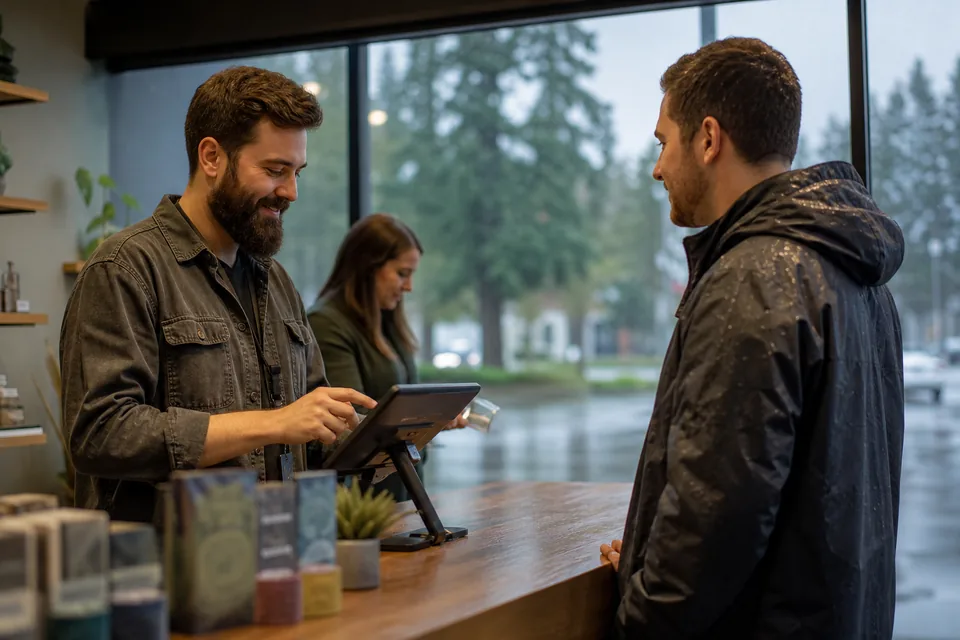
Which POS systems work with CCRS in Washington?
The LCB publishes a list of integrators with CCRS access, and as of its March 4, 2026 update it names fifteen companies: Appspensary, Bamboo Metrix, Blaze Solutions, Canix, Cultivera, DOPE CPA, Dutchie POS, Flourish Software, GrowFlow, Jane Technologies, MaxQ Technologies, Meadow, OpenTHC, Originscale and POSaBIT. Not all of them sell a retail register. Jane is an online menu, Flourish and Canix lean toward cultivation and wholesale, and DOPE CPA is an accounting firm.
Two cautions come with the list. The LCB says plainly that its vetting does not cover software viability or operability, and that the licensee stays responsible for whatever an integrator reports on its behalf. And the integrator page says the LCB is not adding new integrators while CCRS moves to a WA.gov login, which happens on October 12, 2026, with the system down from 5 p.m. to 8 p.m. and new logins available from the morning of October 13. A vendor that is not on the list today cannot get on it during that window.
| POS | On the LCB CCRS list (Mar 4, 2026) | What the vendor says about Washington | Published price |
|---|---|---|---|
| POSaBIT | Yes | Seattle headquarters. Claims to process more than 85% of Washington cannabis point of sale transactions (company press release, March 2025) | None. Quote only |
| Dutchie POS | Yes | Release notes from March 2025 list Washington CCRS manifest and monthly report fixes | None. Reported $499 to $1,000 a month per location |
| GrowFlow | Yes | Own page says GrowFlow Retail integrates with CCRS and is built for Washington dispensaries | None on the page |
| Cultivera | Yes | Seattle-based, sells a POS alongside its cultivation software | None found |
| BLAZE | Yes | On the list; we found no Washington page of its own | None. Reported from $500 a month |
| Meadow | Yes | On the list; markets it names on its pricing page do not include Washington | None. Quote only |
| Cova | No | Washington page still describes reporting to Leaf Data Systems, replaced by CCRS in 2021 | $349 to $599 a month nationally |
| Flowhub, Treez | No | No Washington presence or CCRS claim we could find | Quote only |
Prices for Dutchie and BLAZE are third-party reports, not vendor rate cards. See Dutchie pricing, BLAZE POS pricing and POSaBIT pricing for who published each figure.
How does a Washington POS report to CCRS?
By file, not by live connection. The LCB's CCRS FAQ says there is no application programming interface for CCRS, and that licensees report by submitting a CSV file of new or updated data. The minimum is weekly: the reporting week runs Sunday to Saturday, and every licensee's file is due by the following Sunday. Files should stay under 1 GB. After the April 2025 holiday rush slowed processing, the LCB asked integrators to keep uploads to 250 files an hour.
That changes what you should test in a demo. In a Metrc state you ask whether sales sync in real time. In Washington you ask who generates the weekly file, whether the POS uploads it for you or hands you a CSV to upload yourself, what happens when CCRS rejects a line, and how you see the error. Taxes do not travel through CCRS at all. The monthly retail sales and excise tax report goes to the LCB separately and is due by the 20th of the following month, with a 2% late penalty, so the POS also has to produce that report cleanly.
What does a Washington POS have to calculate at the counter?
Three things set Washington apart from the states most national vendors are built around.
- The 37% excise is in the shelf price and on the receipt. RCW 69.50.535 sets the cannabis excise tax at 37% of the selling price, requires it to be reflected in the price list or quoted shelf price, and requires it to be separately itemized from state and local sales tax on the receipt. Retail sales tax applies on top. A POS built for states that add excise at the register has to be configured the other way round.
- Purchase limits by category. An adult may buy any combination of up to one ounce of usable cannabis, 16 ounces of solid edibles, 72 ounces of liquid edibles, 200 mg of THC in low-dose beverages of 4 mg a unit or less, and seven grams of concentrate. Medical recognition card holders get roughly triple: three ounces, 48 ounces, 216 ounces and 21 grams.
- No delivery and no online sale. WAC 314-55-079 prohibits internet sales and delivery. Online carts are allowed as reservations only; the customer pays and picks up in person. A vendor that sells you a delivery module or online payment in Washington is selling you something you cannot switch on.
Which POS handles Washington medical sales correctly?
The one that keeps the history, and you should test it in the demo rather than take it on trust. Washington exempts medical sales from both taxes when an endorsed store sells compliant products to a recognition card holder: the 37% excise until June 30, 2029 under RCW 69.50.535, and retail sales tax under RCW 82.08.9998. The store has to keep records of each exempt sale, including the card number used, for at least five years.
That record is where software decides the outcome. In Determination No. 23-0051, published in May 2026 as 45 WTD 044, the Department of Revenue upheld an assessment against two endorsed retailers because their point of sale software did not maintain a copy of the original card number when customers received new recognition cards. Staff typed the new number over the old one on the customer profile, so the store could no longer prove the earlier exempt sales, and the exemptions for those sales were denied. The audit covered 2018 to mid-2021.
So ask every vendor to show you, on screen, what happens when a returning patient presents a renewed card. The right answer is a second card record with dates, with every past sale still tied to the number that was valid when it happened. The wrong answer is an editable field. If you run a medical endorsement, this one test is worth more than any feature comparison.
What does a POS cost a Washington dispensary?
Nobody on the LCB list publishes a price, so a Washington buyer has to work from reported figures and quotes. The national reports put Dutchie at roughly $499 to $1,000 a month per location before payments, setup and hardware, and BLAZE from about $500 a month. POSaBIT, GrowFlow, Cultivera and Meadow quote after a demo. Hardware adds roughly $1,000 to $3,500 per register, broken down in our dispensary POS hardware cost guide.
Two Washington-specific lines change the arithmetic. First, the delivery and online payment modules that pad quotes elsewhere are worthless here, so strip them out and ask for the price without them. Second, payments: card networks still exclude cannabis, so most Washington stores take cash and debit, and the processing contract may come bundled with the POS. Ask for software and payments as separate lines, then model the processing on your real weekly debit volume. Every week, the POS daily totals, the processor payouts and the bank deposits also have to agree with each other, and with the excise you report to the LCB each month. Stores with more than one location usually move that matching off spreadsheets and onto reconciliation software before the first audit, not after it.
Washington also caps ownership at five retail licenses per entity, so the multi-store pricing that matters here tops out at five. If you are comparing chain pricing, our guide to the best POS for multi-location dispensaries shows what each vendor charges per extra store.
How to choose a POS for a Washington dispensary
- Start from the LCB list. If a vendor is not on the CCRS integrator list, you will be uploading files yourself, and the LCB is not adding names until after the WA.gov move.
- Ask for a live CCRS rejection. Have the rep show a file CCRS rejected and how the store sees and fixes the line.
- Run the renewed-card test. Ring up a medical sale, renew the patient's card, ring up another, and check both numbers are kept against their sales.
- Check the receipt. The 37% excise should be inside the shelf price and itemized separately from sales tax on the printout.
- Price without delivery. Get the quote with delivery and online payment removed, plus a separate payments line.
- Call two Washington references. A vendor's strength in Michigan or California says little about CCRS. Ask for stores in this state, your size, from the last year.
If you are replacing a system rather than buying a first one, plan four to eight weeks and avoid cutting over in the week a CCRS file is due; the sequence is in how to switch dispensary POS systems. For the wider field outside Washington, our dispensary POS systems comparison covers every major platform on price, meter and fit.
Frequently asked questions
What is the most used POS in Washington state?
POSaBIT says it is. In a March 2025 press release the Seattle company claimed to process more than 85% of Washington cannabis point of sale transactions. That is the company's own figure, and the LCB does not publish market share, but no other vendor makes a comparable Washington claim. Dutchie, GrowFlow and Cultivera are the other well-established names on the CCRS integrator list.
Does Washington use Metrc?
No. Washington runs its own system, the Cannabis Central Reporting System (CCRS), which the LCB launched in December 2021 to replace Leaf Data Systems. CCRS has no API; stores or their software vendors upload CSV files at least weekly. A POS that advertises Metrc integration tells you nothing about how it handles Washington.
Can Washington dispensaries deliver or sell online?
No. WAC 314-55-079 prohibits internet sales and delivery to customers. Stores may let customers reserve products in an online cart, but the customer must pay and collect in person at the licensed store, where staff check ID. Do not pay for a delivery module in Washington.
How is the 37% cannabis tax shown at a Washington dispensary?
It is built into the shelf price, and it must also appear as its own line on the receipt, separate from state and local sales tax. Retail sales tax is then added on top. Endorsed stores selling compliant products to recognition card holders can exempt those sales from both taxes, with records kept for five years.
Find a licensed dispensary near you
Search 21+, state-licensed dispensaries near you, browse real menus and deals, and get a plain-language starting point from the AI budtender. We are a directory, not a seller, and this is not medical advice. Check your local laws.