FOR LICENSED DISPENSARIES
Dispensary ad network and cannabis ad network minimums, from $10 a day self-serve to in-store screens
The short answer
A dispensary ad network is a cannabis-friendly programmatic network, such as Mantis, Surfside, MediaJel, StackAdapt or Traffic Roots, that sells display, native and connected TV placements to licensed shops because Google Ads and Meta will not. What it really costs depends on who runs the campaign. Mantis, the only network we found that publishes its terms, has no monthly minimum on self-serve, a $10 a day floor per campaign and a $250 minimum deposit, while its managed service requires at least $25,000 a month in media. Agencies report $3,000 to $5,000 a month as the working minimum for a managed dispensary campaign. In-store screen networks run the other direction: they put screens in your store and sell your shoppers to brands. A claimed listing on Dispensaries is $99 a month, published.
Listed from $99/mo · license verified · cancel anytime · we never sell or ship
This is what buyers see when they search your area
Press Find dispensaries to see licensed shops near .
Searching licensed dispensaries near ...
example listings ·
Sorted by distance
Not medical advice · 21+ · check your local laws
These shops, ratings, prices and deals are examples that show how a listing looks.
$10/day
Mantis minimum daily spend per campaign, self-serve, from its own help center
$25,000/mo
Mantis managed service minimum media spend, from its own pricing page
$0.50
Average floor CPM Trillboards publishes for its dispensary screen inventory
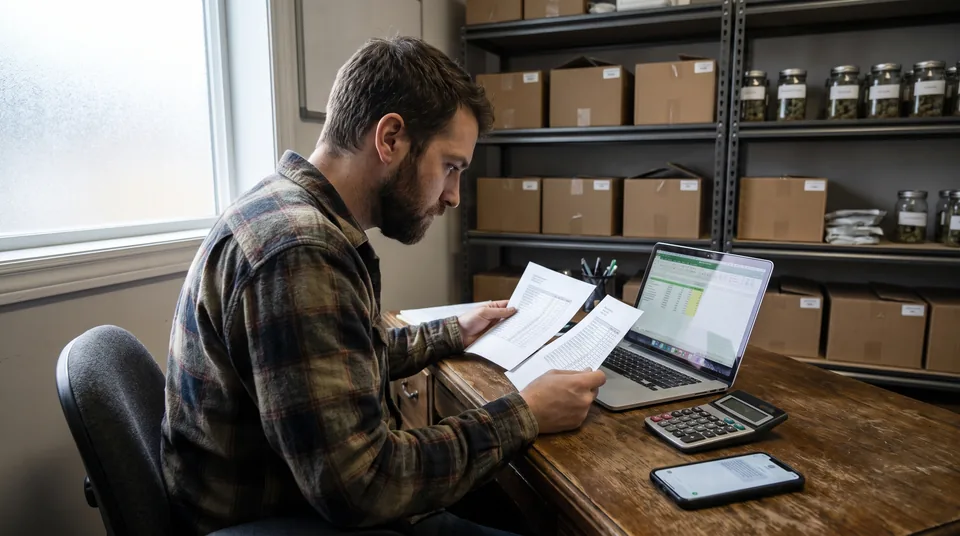
Most dispensary owners who type "dispensary ad network" into a search bar are asking one of two different questions, and the answers do not overlap. The first is where a licensed shop can buy paid reach now that Google and Meta are closed to THC retail. The second is whether to let a company bolt advertising screens to the wall of the sales floor and pay you, or not, for the privilege. Both get called an ad network, and vendor pages blur them on purpose.
This page separates them and prices both from the terms the networks publish themselves, which turns out to be a short list. Only one programmatic network we checked in October 2026 puts its minimums in writing. Everyone else quotes. Where a figure comes from an agency or a single reviewer rather than from the network, the table says so, because in this category the company quoting a number is usually the company that sells it.
Why it works
What to settle before you fund a cannabis ad network
Ask which minimum you are being quoted
A self-serve account and a managed account at the same network can differ by a factor of eighty. Mantis self-serve has no monthly minimum; its managed tier starts at $25,000 a month in media. Get the quote to name the tier and the media floor separately from any management fee.
Separate media from the fee
Programmatic bills are two numbers: what reached the exchange and what the network or agency kept. Mantis describes its managed fee only as less than a full-time hire. Ask for the fee as a percentage of media, in writing, before you compare two proposals.
Confirm the network will run THC retail, not just CBD
Several networks that accept cannabis brands are narrower about licensed retail. Send your actual creative and landing page through review before you sign, because approval in the sales call is not approval at the creative desk.
Geofence to the drive you actually serve
A single-location shop pays for every impression outside the radius people will drive. Set the fence to your real trade area, often a few miles, and exclude neighboring states where the ad would be unlawful to serve.
Set a test length and a kill date
At a few dollars per thousand impressions a small budget produces a thin signal. Decide the spend, the length and the store-visit or redemption number that counts as working before the campaign starts, then stop it if the number is not there.
Fund discovery before reach
Someone who sees a banner still has to find your menu. Shops that are invisible in the directories and the local pack pay for reach and then lose the buyer at the moment of choice. Fix the listing first, then buy reach on top of it.
How it works
Four steps, in the order that actually pays
Get the free and owned layer working
Google Business Profile, accurate hours, a readable menu, answered reviews and an opted-in text list. These cost nothing and they decide where a nearby buyer goes once they are already searching.
Buy discovery where buyers already browse
A claimed, license-verified directory listing puts your menu and deals in front of adults choosing a shop in your area. On Dispensaries that is $99 a month, published, cancel anytime.
Test one ad network self-serve, small
Open a self-serve account, fence it to your trade area, run one offer with a trackable redemption, and cap the spend. Mantis lets you do this from a $250 deposit and $10 a day.
Scale or hand off only on evidence
If redemptions justify the spend, raise the budget or bring in a managed team. If they do not, you have spent a few hundred dollars learning it, not a $25,000 month.
The meter test
The monthly floor depends on who runs the campaign
Monthly minimum to get a campaign live, by route. Gray bars are terms the network or vendor publishes itself. Colored bars are figures reported by agencies or a single reviewer, so treat them as the shape of a quote, not the quote. The Mantis self-serve bar is its $10 a day campaign floor over 30 days.
The numbers
Every dispensary ad network we checked, and what its own terms say, October 2026
| Network | What it sells | Minimum or price | Who published that figure | Best fit |
|---|---|---|---|---|
| Mantis, self-serve | Cannabis display, native and recommended content ads, real-time bidding on CPM or CPC | No monthly minimum. $10 a day per campaign, $250 minimum deposit. Native CPC from $0.30 | Mantis, in its own help center and pricing page | A single shop testing paid reach with a capped budget |
| Mantis, managed | The same inventory with a dedicated team, attribution and proposals | At least $25,000 a month in media, plus an unstated management fee | Mantis pricing page | MSOs and multi-state brands |
| Surfside | Programmatic buys on cannabis-friendly publishers, plus ads on retailer ecommerce menus | Not published | Nobody. Quote only | Operators who also want on-menu commerce media |
| MediaJel | Full-service programmatic, CTV, DOOH, SEO and SMS for regulated categories | Not published. Its own page steers single-location shops to a free course first | MediaJel, on fit; no price anywhere | Multi-location operators with an established program |
| StackAdapt | Self-serve programmatic platform with a regulated-industries review team | Not published for cannabis | Nobody | Agencies and in-house teams already buying programmatic |
| Traffic Roots | Cannabis display network | Reported $2,500 a month minimum plus a $150 platform fee | A single Capterra reviewer, January 2024, unconfirmed | Get the minimum in writing before you rely on it |
| In-store screen networks (Enlighten, Trillboards) | Screens on your sales floor that run brand ads to your shoppers | You are the inventory. Trillboards publishes a $0.50 average floor CPM for dispensary screens | Trillboards venue page, May 2026 snapshot | Shops weighing screen income against control of their own walls |
| Dispensaries listing | A claimed, license-verified listing with menu, deals and local search visibility | $99 a month, cancel anytime | Us, on our pricing page | Every licensed shop, before any paid reach |
Network terms change. Figures were read from each company's own site in October 2026 except where marked as reported. Advertising rules for cannabis vary by state; confirm the rules for every state your campaign can reach.
Swipe to see more →
What is a dispensary ad network?
A dispensary ad network is an advertising marketplace that will sell paid placements to a state-licensed cannabis business when the mainstream platforms will not. Google Ads prohibits THC dispensary advertising and Meta prohibits cannabis ads outright, so networks such as Mantis, Surfside, MediaJel and Traffic Roots aggregate publishers that accept the category and resell that inventory with targeting, usually by geography and age.
The term also covers a second, unrelated product: in-store screen networks. Companies such as Enlighten and Trillboards install digital screens inside dispensaries and sell that screen time to cannabis and national brands. In that arrangement you are not buying ads, your store is the media. A shop owner comparing "ad networks" needs to know which of the two a sales rep is selling before the first call ends.
Both sit inside a wider budget. For the full picture of what every channel costs, including directories, SEO and loyalty, see dispensary marketing cost, and for where cannabis ads are allowed at all, dispensary advertising channels and what they cost.
How much does a cannabis ad network cost?
A cannabis ad network costs as little as $10 a day on a self-serve account and $25,000 a month or more on a managed one, and the difference is almost entirely who does the work. Those two numbers are the only published minimums we found, and both are Mantis. Its help center states there is no monthly or annual minimum media spend on any payment plan, every campaign needs at least $10 a day, and account top-ups start at $250. Its pricing page sets the managed service at media spend of at least $25,000 a month, plus a fee it describes only as less than a full-time hire.
Everything between those poles is quoted. Agencies that sell managed cannabis programmatic report about $3,000 to $5,000 a month as the practical floor, with display CPMs around $3 to $8 and video and connected TV around $15 to $30. Those are sellers describing their own product, so read them as a range to negotiate inside, not a market rate.
Put the arithmetic in front of the quote. At an $8 CPM, $300 a month buys about 37,500 impressions, and $3,000 buys about 375,000. Fenced to a few miles around one store, the smaller number is enough to learn whether an offer moves anyone, and not enough to move a market. That is the honest use of a self-serve test.
- Mantis self-serve: no monthly minimum, $10 a day per campaign, $250 deposit, native CPC from $0.30.
- Mantis managed: $25,000 a month minimum media, management fee on top.
- Agency managed programmatic: reported $3,000 to $5,000 a month working minimum.
- Everyone else: quote only, so ask for media and fee as two separate lines.
Which ad networks accept dispensary ads?
The networks that openly accept licensed dispensary advertising in 2026 are cannabis-specialist ones: Mantis, Surfside, MediaJel and Traffic Roots, plus general programmatic platforms such as StackAdapt that run cannabis through a regulated-industries review. Acceptance is per creative and per state, not per account, so an approved account can still have an ad rejected for the wrong claim, the wrong audience or the wrong geography.
Mainstream platforms remain closed. Google Ads prohibits recreational and medical THC dispensary ads, Meta prohibits cannabis ads on Facebook and Instagram with narrow exceptions for certified hemp CBD, and the large social platforms follow the same line. If an agency tells you it can run your dispensary on Google search ads, ask exactly how, because the honest answer is that it cannot. Our cannabis advertising laws by state page covers the state audience rules every network applies on top of its own.
Is a cannabis ad network worth it for a single dispensary?
For a single dispensary, a cannabis ad network is worth a capped self-serve test only after the free channels and a directory listing are working, and rarely worth a managed contract. The reason is the order a buyer moves in. Paid display creates awareness, but the purchase is decided when the person searches nearby shops, reads menus and picks one. A banner that sends someone to a shop with no visible menu and no claimed listing pays for the awareness and hands the sale to the competitor who shows up at the decision.
MediaJel, which sells managed programmatic, says nearly the same thing on its own site: it describes itself as built for multi-location operators and brands, and points single-location shops to a free course first. When a vendor tells smaller buyers not to buy yet, that is worth hearing.
Where a network does make sense for one store is a specific, time-bound push: a grand opening, a new license in a market with no awareness, a holiday offer with a redeemable code. Fence it tightly, measure redemptions, and stop on the date you set.
Should you put an in-store ad network's screens in your dispensary?
Taking an in-store ad network's screens can bring in some revenue or free hardware, but it trades control of your sales floor for it, and the published economics are thin. Trillboards is the only dispensary screen network we found that publishes numbers: 41 approved dispensary screens across 29 US cities in its May 2026 snapshot, at an average floor CPM of $0.50, with cleared prices typically 20 to 40 percent higher. At those rates a screen needs a lot of shopper traffic to be worth much to the host.
The structural objection is the one dispensary software makers raise: an ad network plays whatever its brand customers paid for, not what you need to sell this week. If your margin is in house brands or slow inventory, a screen promoting a competitor's product line works against you. Ask how revenue is shared, whether you can block categories or brands, who owns the hardware if you leave, and whether the screens also carry your live menu.
If what you actually want is menu screens that sell your own inventory, that is a different purchase. We compare those on dispensary menu boards.
Should a dispensary buy an ad network or a directory listing first?
A directory listing comes first for almost every licensed shop, because it is where a buyer who has already decided to purchase chooses between stores, and it is priced monthly rather than by the impression. Directory placement on the large platforms is quoted per market; see what Weedmaps advertising costs and Leafly pricing for dispensaries for the reported ranges and who reported them.
Dispensaries publishes its price instead. A claimed, license-verified listing is $99 a month, carries your live menu, daily deals and hours, and sits only next to other licensed shops. Get that working, then decide whether paid reach on top of it is worth a test.
Questions owners ask
Dispensary ad network, answered
Keep reading
More for licensed dispensary owners
Dispensary advertising
Where cannabis dispensary ads are allowed in 2026 and what each channel costs.
Read moreDispensary marketing cost
Every channel priced, with a column for who published each number.
Read moreCannabis advertising laws by state
The 21-and-over audience rules every ad network applies on top of its own.
Read moreWeedmaps pricing
What directory placement on Weedmaps is reported to cost, and the filed average.
Read moreBest dispensary menu boards
Screens that sell your own inventory rather than a brand's.
Read moreDispensary listing prices
Listed, Featured and Market Leader, with published monthly prices in USD.
See pricingGet your licensed shop in front of buyers near you.
Claim a verified listing, publish your menu and daily deals, and show up when adults in your area go looking for a dispensary. Listed is $99 a month, and you can cancel anytime.
State-licensed dispensaries only · 21+ · Dispensaries is a directory and ad platform, we never sell, ship or process cannabis orders · cannabis laws vary, check your local laws · general information, not legal advice